


Leratiomyces erythrocephalus (Tul. & C. Tul.) Beever & D.-C. Park 2008



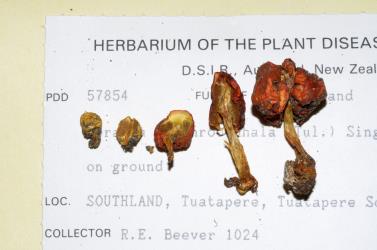





Show more
 Details

 Details
Leratiomyces erythrocephalus (Tul. & C. Tul.) Beever & D.-C. Park, Mycotaxon 103 116 (2008)
Leratiomyces erythrocephalus (Tul. & C. Tul.) Beever & D.-C. Park 2008
Biostatus
Nomenclature
Beever & D.-C. Park
Tul. & C. Tul.
(Tul. & C. Tul.) Beever & D.-C. Park
2008
116
ICN
species
Leratiomyces erythrocephalus
Classification
Vernacular names
Synonyms
- Clavogaster erythrocephalus (Tul. & C. Tul.) Lintott 1977
- Nivatogastrium lignicola E. Horak 1971
- Nivatogastrium sp. 'Pororari (PDD 87061)' J.A. Cooper ined.
- Secotium agaricoides sensu Hollós 1902
- Secotium czerniaievii sensu Colenso 1891 [1890]
- Secotium erythrocephalum Tul. & C. Tul. 1844
- Secotium lutescens Lloyd 1908
- Weraroa erythrocephala (Tul. & C. Tul.) Singer & A.H. Sm. 1958
Associations
 View full associations record

Descriptions
In grassy places. Banks' Peninsula, Waitaki, Dunedin, Maungaroa, Wellington (Mr. Travers).
Distribution.-Tasmania; N.Z. (Herb. Nos. 120, 610, 938, 1097). Common throughout the lowland forests of New Zealand.
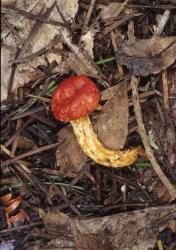
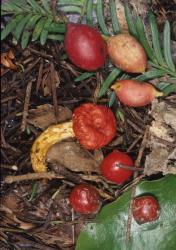
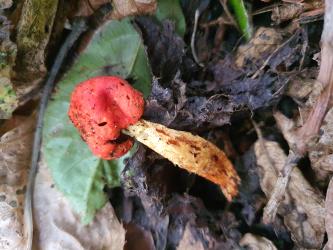
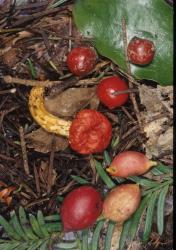
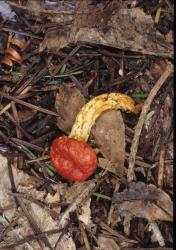
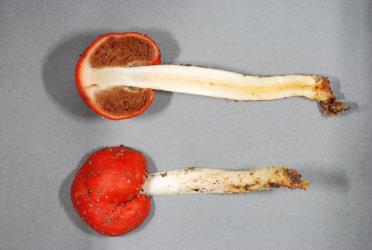
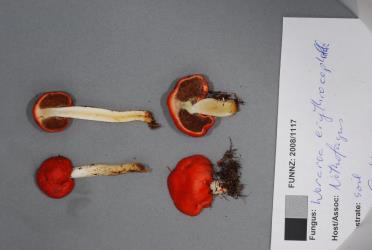
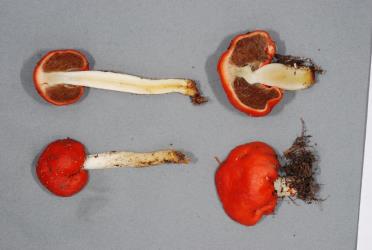
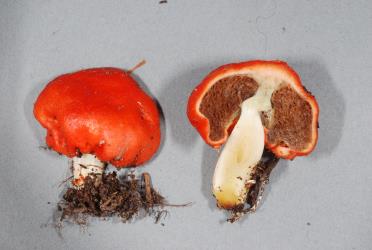
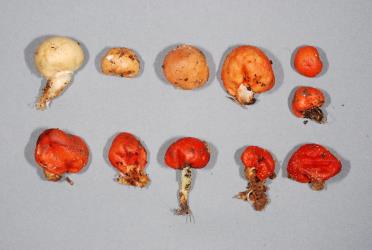
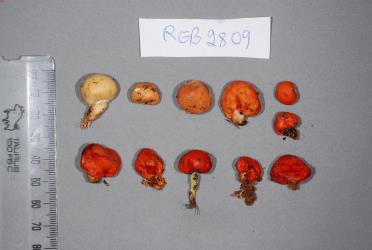
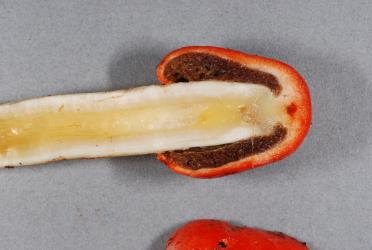
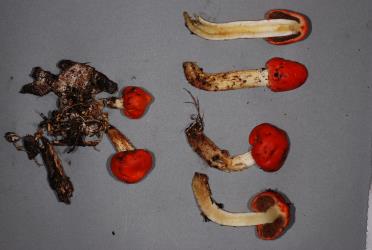
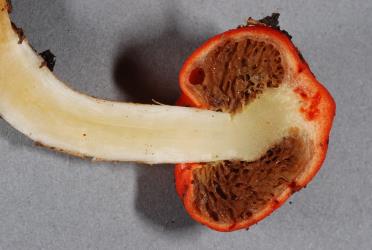
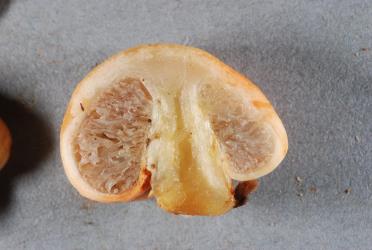
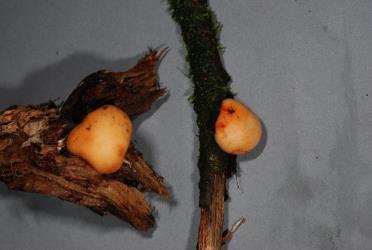
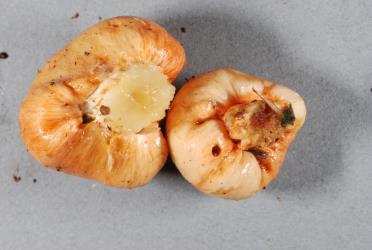
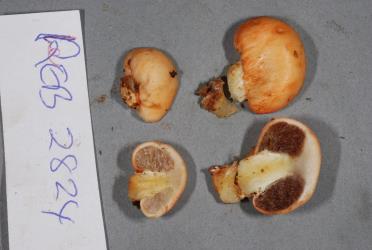
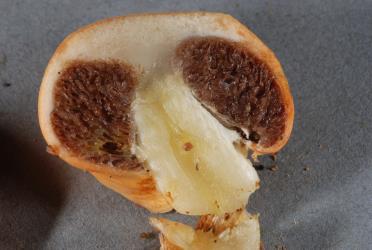
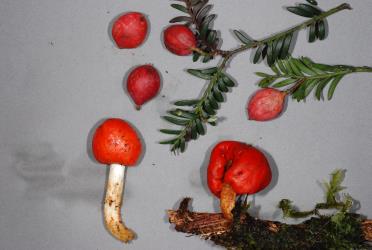
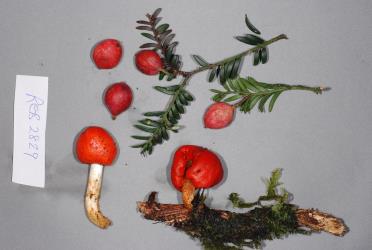
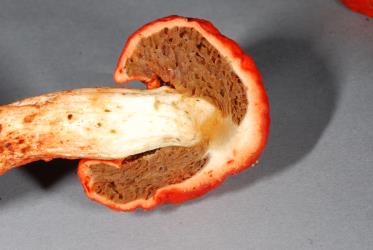
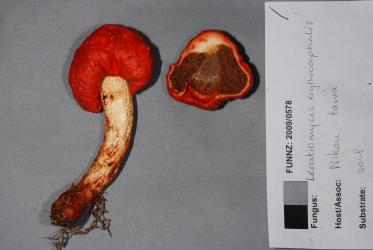
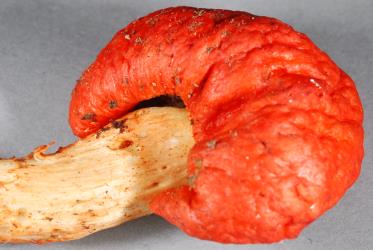
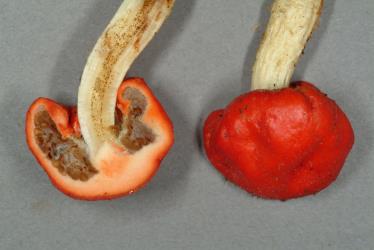
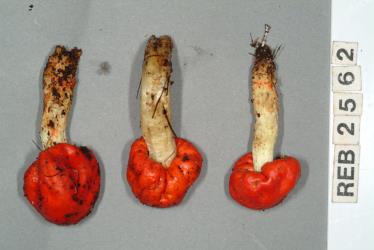
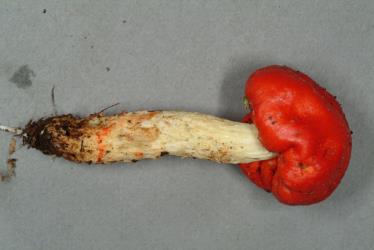
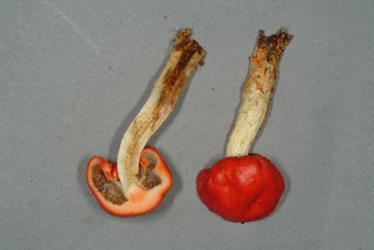
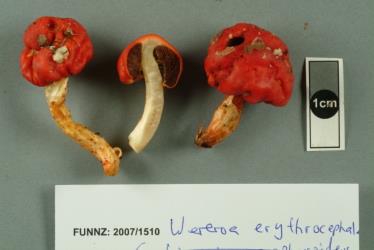
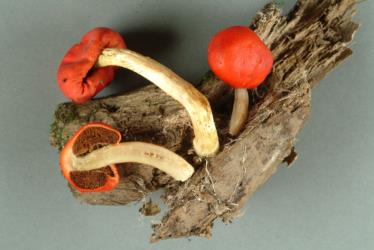
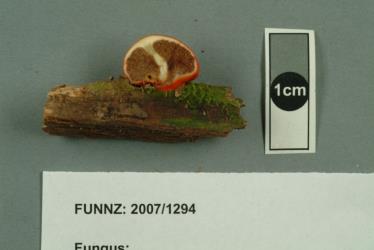
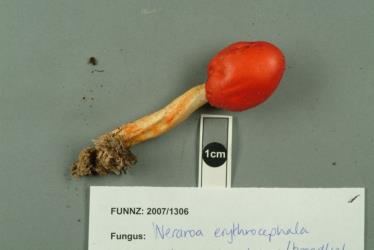
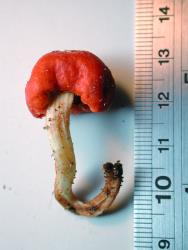
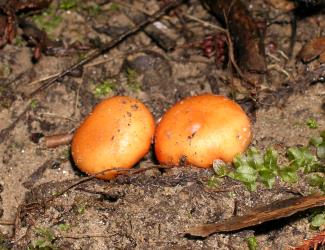
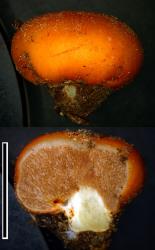
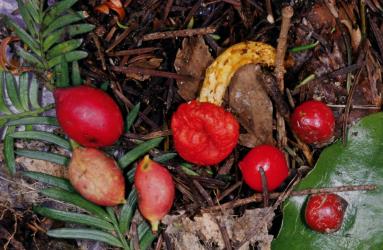
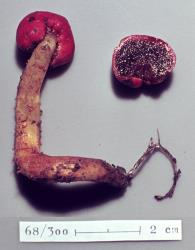
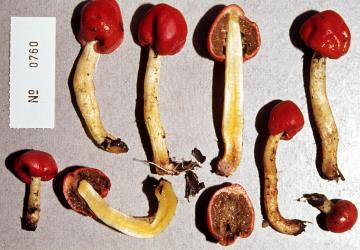
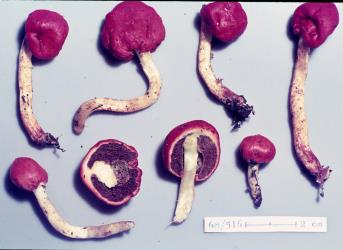
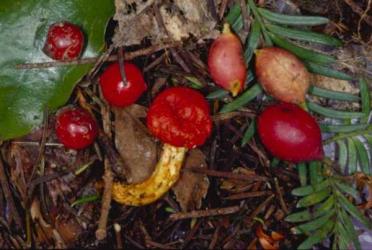
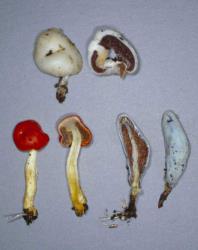
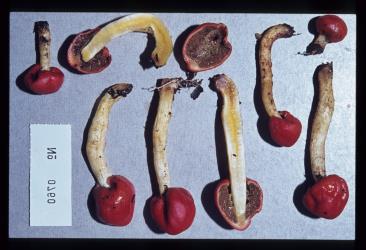
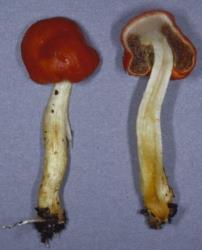
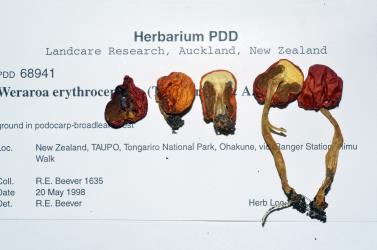
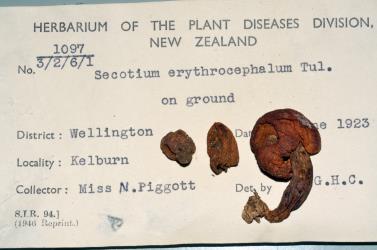
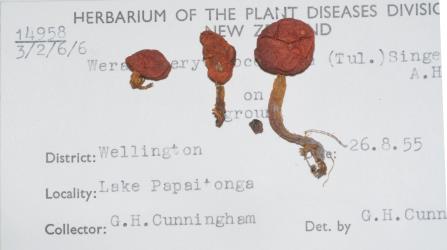
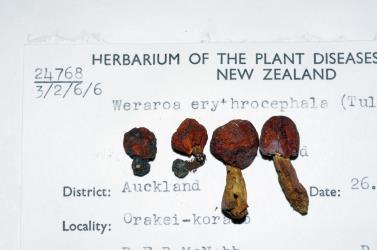
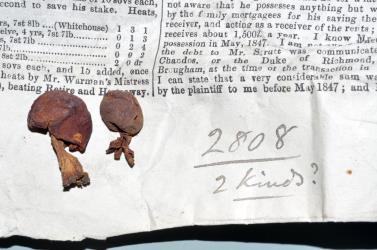
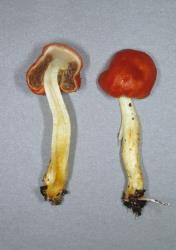
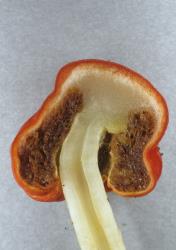
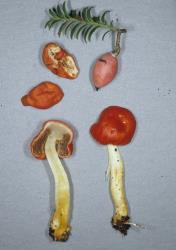
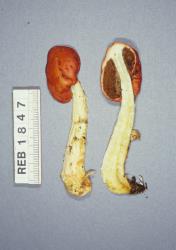
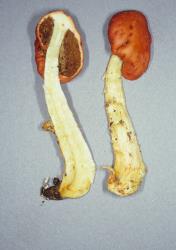
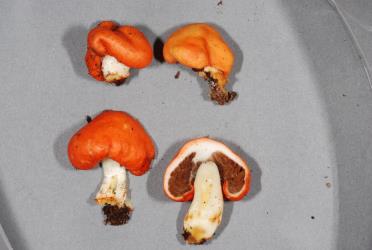
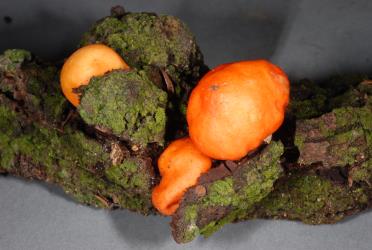
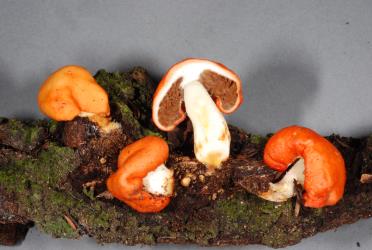
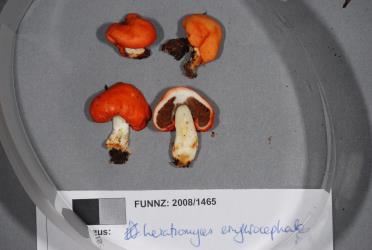
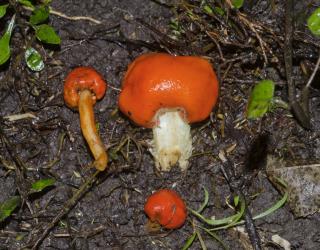
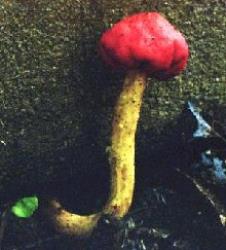
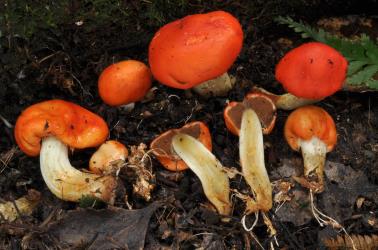
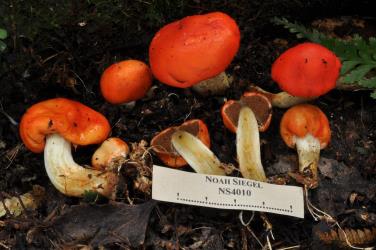
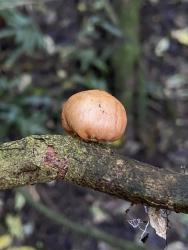
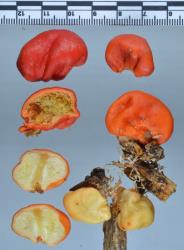
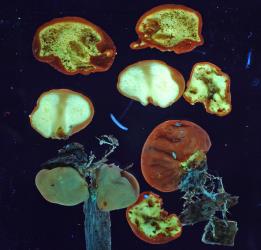
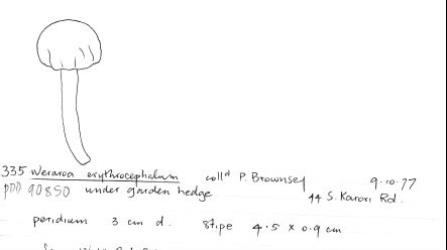
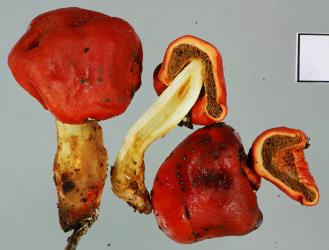
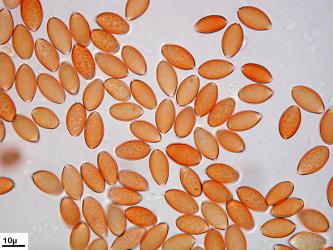
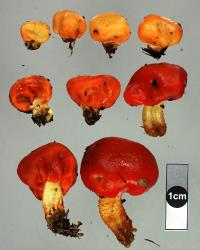
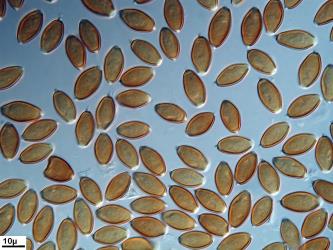
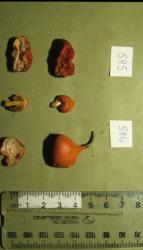
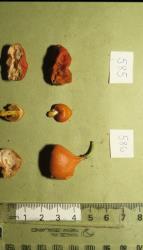
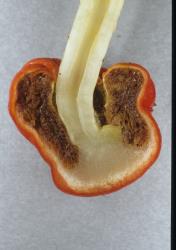
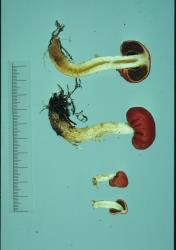
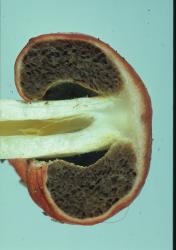
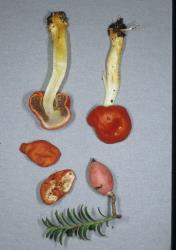
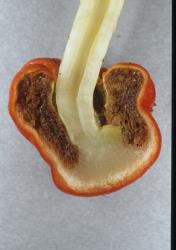
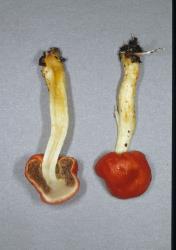
Peridium scarlet, globose, depressed-globose or ovate, apex obtuse or rounded, base excavated, truncate or decurrent, 2-4 cm. high, up to 6 cm. wide, smooth, frequently somewhat lobed, glabrous, shining, often slightly viscid; retaining its colour when dried. Stipe bright yellow, slender, up to 10 cm. long, 3-10 mm. thick, equal, smooth or fibrillose, often polished, hollow; columella slightly expanded at the apex. Gleba ferruginous, cellular, cells polygonal or slightly elongate, up to 3 mm. long, numerous, dissepiments thin. Spores smooth, pallid ferruginous, elliptical or elliptic-ovate, bluntly pointed at one or both ends, 12-25 x 7-11 µ, (Tulasne, 12 x 5 µ; Massee 10-11 x 5 µ; Lloyd, about 12 x 6 µ).
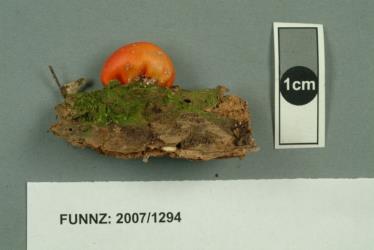
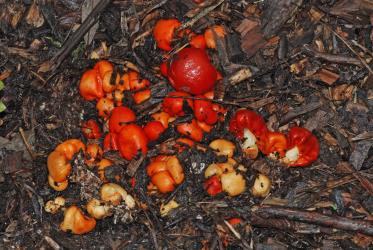
Habitat.-Gregarious or solitary on decaying wood on the forest floor.
I have collected this species at Auckland, Hamilton, Cambridge, Rotorua, Te Aroha (Auckland Province) ; Weraroa, Mt. Waiopehu, York Bay and Botanical Gardens (Wellington Province) ; and have received collections from Peel Forest (from Dr. H. H. Allan), and Governors Bay (from Mr. J. F. Tapley), Canterbury Province; and Dun Mt., Nelson Province (from Mr. J. C. Neill). It is not confined to the forest, for several collections have been obtained from flower gardens, especially where these have been at one,time in forest. It is commonly stated that this species grows on the ground; but although I have collected hundreds of these plants, I have always found them to be attached to decaying wood.
The scarlet colour of the peridium separates this from any other species, but in glebal and spore characters it is closely allied to S. virescens and S. superbum.
The spore measurements I have given are much greater than those given by other writers. But with certain large forms found here, spores of a length of 25 µ are not uncommon. I believe that it would be inadvisable to separate these forms, for they are identical in all other respects. Furthermore, intermediate stages, in which the spores vary in size between the large and small spore forms, are not uncommon.
This species was named by Tulasne from material collected at Akaroa, Banks Peninsula, Canterbury, by Raoul, now preserved in the museum herbarium at Paris.
HOLOTYPE: PDD 27003 (Isotype Herb. Hk. ZT 68/519: "On rotten wood in forest of Podocarpus, Dacrydium, Griselinia, Coprosma, Pittosporum etc.: Filter Station, Dunedin, New Zealand: leg. Horak and Baylis, 30. V. 1968".
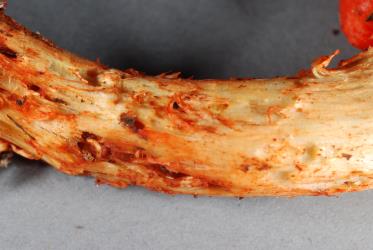
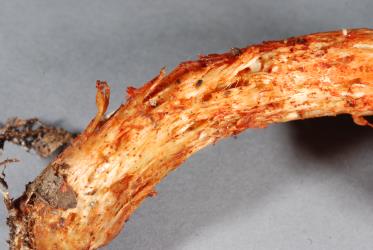
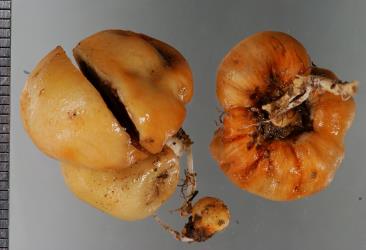
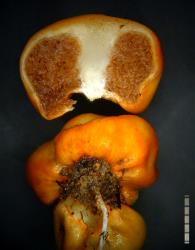
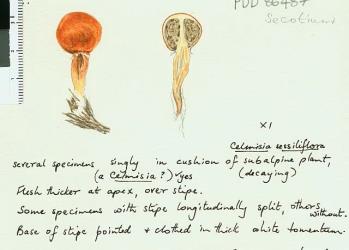
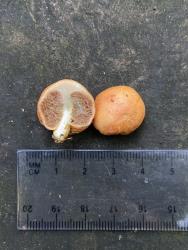
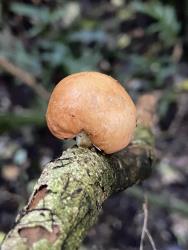
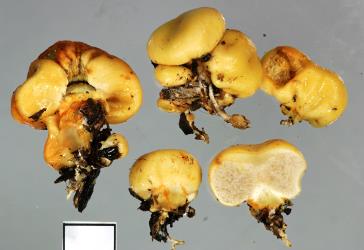
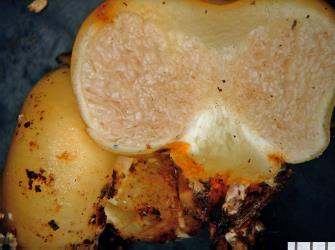
Pileus 5-15 mm diam., hemispherical or conical when young, becoming pulvinate, margin strongly incurved and connected with stipe-columella; yellow brown with distinct reddish or orange tinge; smooth, slightly viscid, non striate; margin conspicuously covered with orange or reddish coloured veil remnants. Gleba cellular, cells about 1-2 mm diam., not distinctly radially arranged; brownish, without well differentiated tramal plates, not gelatinised. Stipe 6-20 x 3-4 mm, cylindrical or fusoid, attenuated towards the apex (columella), normally transcurrent and extending to the cortex of the cuticle but rarely terminating abruptly in the gleba; yellow, ornamented with distinct, adpressed, orange or reddish coloured zones forming one or more girdles of the veil; when wet slightly viscid, becoming dry with age. fistulose. Context whitish, under the cortex of the pileus yellow-brown, up to 2 mm diam. Chemical reactions on pileus: KOH—brown. Smell and taste not distinctive.
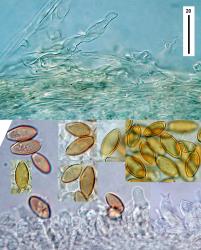
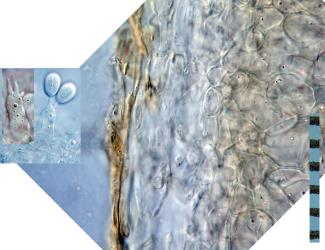
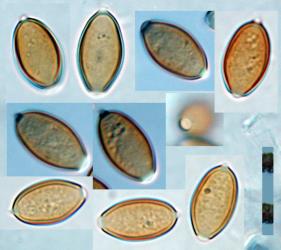
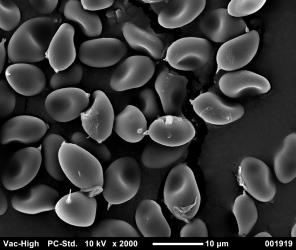
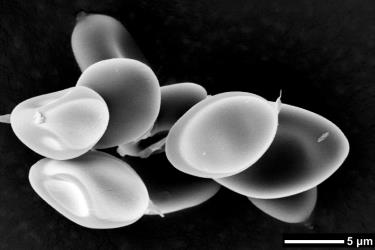
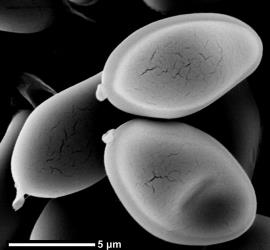
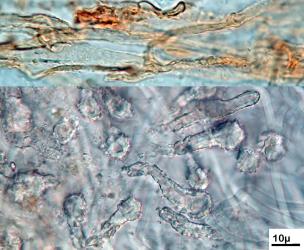
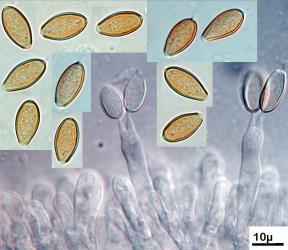
Spores 13.5-16 x 8-10 µm, elliptical, sometimes even naviculate, smooth, brownish yellow, with distinct germ pore, membrane up to 1µm diam., axially symmetrical. Basidia 23-31 x 7-9 µm., 4-spored. Chrysocystidia 30-40 x 8-10 µm, fusoid, with short terminal projections, coloured by yellow plasmatic pigment, membrane hyaline and thin-walled. Cuticle a cutis consisting of cylindrical, repent hyphae (3-10 µm), membrane gelatinised, encrusted by yellowish pigment, clamp connections present.
Spores 13.5-16 x 8-10 µm, elliptical, sometimes even naviculate, smooth, brownish yellow, with distinct germ pore, membrane up to 1µm diam., axially symmetrical. Basidia 23-31 x 7-9 µm., 4-spored. Chrysocystidia 30-40 x 8-10 µm, fusoid, with short terminal projections, coloured by yellow plasmatic pigment, membrane hyaline and thin-walled. Cuticle a cutis consisting of cylindrical, repent hyphae (3-10 µm), membrane gelatinised, encrusted by yellowish pigment, clamp connections present.
On rotten wood. New Zealand.
Characteribus generis adsunt; pilco 5-15 mm lato, marginem versus inflexo et fragmentibus fibrillosis e velo instructo, luteobrunneo vel aurantiocastaneo. Gleba cavernis 1-2 mm latis consistente, cellulis ± radialiter disposita. Stipite 6-20 x 3-4 mm, cylindraceo vel subfusoideo, fistuloso, columella angustiori et apice cuticulam pilei attingente, luteo, viscido, velo aurantiorubro fibrillosoque ornato. Caro gelatinosa. Odore saporeque nullo. Sporis 13.5-16 x 8-10 µm. Basidiis 23-31 x 7-9 µm. Chrysocystidiis 30-40 x 8-10 µm, sparsis, tenuitunicatis, fusoideis, pigmento luteo instructis. Epicute ex hyphis cylindraceis pigmento incrustatis et membrana gelatinosa instructis, fibuligeris. Ad lignum putridissimum. Novazelandia.
Holotypus: PDD 27003: "Dunedin; leg. Horak, 3C.V.1968".
Taxonomic concepts
Clavogaster erythrocephalus (Tul. & C. Tul.) Lintott 1977
Clavogaster erythrocephalus (Tul. & C. Tul.) Lintott (1977)
Leratiomyces erythrocephalus (Tul. & C. Tul.) Beever & D.-C. Park 2008
Leratiomyces erythrocephalus (Tul. & C. Tul.) Beever & D.-C. Park (2008)
Leratiomyces erythrocephalus (Tul. & C. Tul.) Beever & D.-C. Park 2008
Leratiomyces erythrocephalus (Tul. & C. Tul.) Beever & D.-C. Park (2008)
Nivatogastrium lignicola E. Horak (1971)
Nivatogastrium lignicola E. Horak (1971)
Nivatogastrium lignicola E. Horak (1971)
Nivatogastrium lignicola E. Horak (1971)
Nivatogastrium lignicola E. Horak (1971)
Secotium agaricoides sensu Hollós 1902
Secotium agaricoides sensu Hollós (1902)
Leratiomyces erythrocephalus (Tul. & C. Tul.) Beever & D.-C. Park 2008
Secotium czerniaievii sensu Colenso (1891) [1890]
Secotium czerniaievii sensu Colenso (1891) [1890]
Leratiomyces erythrocephalus (Tul. & C. Tul.) Beever & D.-C. Park 2008
Secotium erythrocephalum Tul. & C. Tul. (1844)
Secotium erythrocephalum Tul. & C. Tul. (1844)
Secotium erythrocephalum Tul. & C. Tul. (1844)
Secotium erythrocephalum Tul. & C. Tul. (1844)
Secotium erythrocephalum Tul. & C. Tul. (1844)
Secotium erythrocephalum Tul. & C. Tul. (1844)
Secotium erythrocephalum Tul. & C. Tul. (1844)
Secotium erythrocephalum Tul. & C. Tul.
Secotium erythrocephalum Tul. & C. Tul. (1844)
Secotium erythrocephalum Tul. & C. Tul. (1844)
Secotium erythrocephalum Tul. & C. Tul. 1844
Secotium erythrocephalum Tul. & C. Tul. (1844)
Secotium erythrocephalum Tul. & C. Tul. (1844)
Secotium erythrocephalum Tul. & C. Tul. (1844)
Secotium erythrocephalum Tul. & C. Tul. (1844)
Leratiomyces erythrocephalus (Tul. & C. Tul.) Beever & D.-C. Park 2008
Secotium erythrocephalum Tul. & C. Tul. (1844)
Secotium lutescens Lloyd (1908)
Leratiomyces erythrocephalus (Tul. & C. Tul.) Beever & D.-C. Park 2008
Weraroa erythrocephala (Tul. & C. Tul.) Singer & A.H. Sm.
Weraroa erythrocephala (Tul. & C. Tul.) Singer & A.H. Sm. (1958)
Weraroa erythrocephala (Tul. & C. Tul.) Singer & A.H. Sm. 1958
Leratiomyces erythrocephalus (Tul. & C. Tul.) Beever & D.-C. Park 2008
Weraroa erythrocephala (Tul. & C. Tul.) Singer & A.H. Sm.
Weraroa erythrocephala (Tul. & C. Tul.) Singer & A.H. Sm. (1958)
Weraroa erythrocephala (Tul. & C. Tul.) Singer & A.H. Sm. (1958)
Weraroa erythrocephala (Tul. & C. Tul.) Singer & A.H. Sm. (1958)
Weraroa erythrocephala (Tul. & C. Tul.) Singer & A.H. Sm. (1958)
Weraroa erythrocephala (Tul. & C. Tul.) Singer & A.H. Sm. (1958)
Weraroa erythrocephala (Tul. & C. Tul.) Singer & A.H. Sm. (1958)
Weraroa erythrocephala (Tul. & C. Tul.) Singer & A.H. Sm. (1958)
Global name resources
Collections
Leratiomyces erythrocephalus (Tul. & C. Tul.) Beever & D.-C. Park 2008
New Zealand
Mid Canterbury
Identification keys
Metadata
dd961b33-56e8-4854-96e5-62529aaf8fd1
scientific name
Names_Fungi
4 July 2008
22 July 2026
